


Case study · DACCM for DeeLab Academy
One platform runs a global academy.
From first click to verified certificate. How we built DACCM, the system that runs DeeLab Academy with a small team and AI that works under human control.
- +65%new trainees, Sep vs Aug
- 82countries
- 841trainees
- 1,290enrolments
As of September 2026.
At a glance
- Project
- DACCM, DeeLab Academy Course and Certification Management
- Client
- DeeLab Academy, part of DeeLab.ai (Singapore)
- Industry
- Training and certification for data and AI skills
- Upsolut’s role
- Product design, engineering, hosting and support
- Live since
- July 2026
- Stack
- Laravel and PHP with MariaDB on Ubuntu Linux; Moodle; Keycloak single sign-on; Stripe and Wise; Anthropic Claude
- Reach
- 1,290 enrolments from 82 countries (Sep 2026)
- See it
- deelabacademy.com (opens in a new tab)
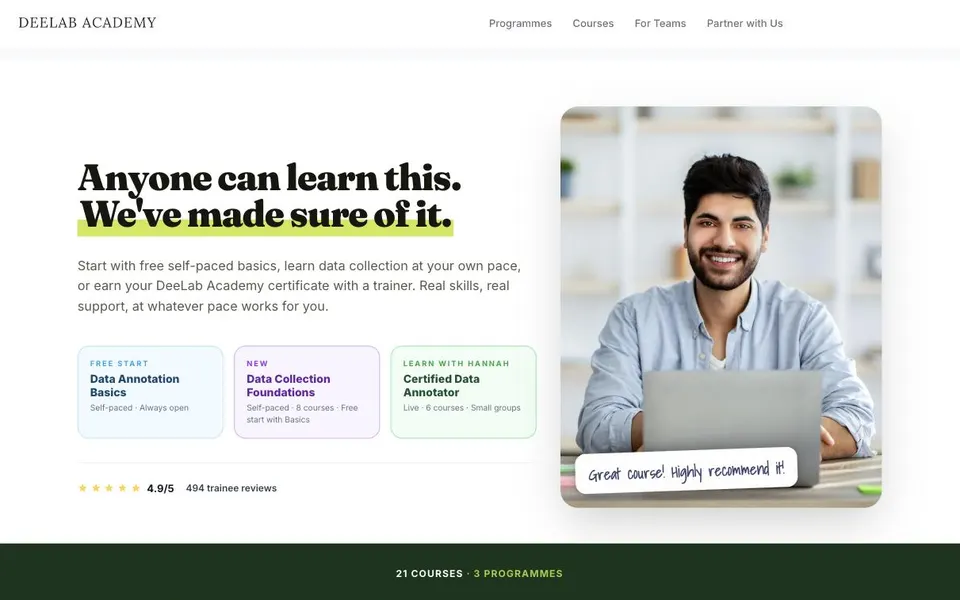
DeeLab Academy trains and certifies specialists in data and AI. DACCM runs all of it: the website, payments, cohorts, learning, certificates, marketing and finance. Employers she shares a certificate with can check it in seconds, and graduates can go on to work opportunities on DeeLab Gigs.
The challenge
A proven idea, run by hand.
DeeLab Academy began as a side project (opens in a new tab) of DeeLab. With very limited resources, every step ran by hand.
Sign-ups by web form
Every open course had its own WordPress page and form. Each sign-up was copied into Google Sheets, and every payment check and course invitation was done by hand.
A login for every tool
Trainees needed a separate username and password for Label Studio, CVAT and Moodle, each created by hand.
Certificates made one by one
Each certificate was made in desktop software and added by hand to a verification page on deelab.ai. Employers could check it, but every update took team time and was prone to errors.
Jessica, before
Take Jessica, a career changer in Philadelphia. She filled in a course form, then waited for someone to check her payment and reply. Her course details, records and tool access were all handled by hand, and after she passed, her certificate arrived when someone had time to make it.
What it needed
It worked, and it proved the idea: DeeLab’s own academy could fly. To grow, it needed one platform that sells worldwide, runs cohorts with a small team, issues credentials employers trust and feeds DeeLab’s talent pool, so a small team can do more, and do it better, with automation and intelligence.
Our approach
Four goals shaped everything.
We started with what the academy needed to achieve: all information in one place, faster flows of data and work, and better efficiency and satisfaction for trainees and staff alike.
One source of truth.
Programmes, courses, trainers, trainees, feedback and campaigns all live in DACCM. Planning, course development, communication and marketing run on that same data.
Automate the flow.
Payments, enrolments, notifications, certificates and campaigns run on their own. APIs connect analytics, ads and email tools, and live dashboards show it all.
Put AI to work.
AI helps support trainees and trainers, develop courses and programmes, and run marketing. People make the final call.
A clear path to work.
Every course pass opens the way to the DeeLab Gigs talent pool, where data and AI opportunities are growing.
The trainee journey
Two ways through. People decide where it matters.
DACCM automates as much as it can, so information and tasks flow smoothly for trainees and staff. People stay closely involved: trainers lead every live cohort and staff oversee every course. The only formal decision is the trainer recording a live cohort pass; self-paced courses need none.
- Staff or trainer decides
- Where every course leads
- The trainee and the system
Live cohort courses 12 steps · 1 decision
Booking
- Finds a programme or courseFinal or estimated prices in her local currency, depending on the currency.
- PaysBy card, or with Wise, which also enables bank transfer.
- Sets up her accountAfter payment, a confirmation email links to account creation, or to her dashboard if she already has an account.
- Waits for her cohortHer seat is held. She or staff can move her to another date or course without touching the payment.
Learning
- Cohort opensAutomatically, once enough seats are filled. Staff can also choose to run it with fewer.Staff option
- Enrolled automaticallyDACCM marks her active and links her to Label Studio and CVAT.
- Single sign-onOne login for the academy, Moodle, Label Studio and CVAT.
- Learns with her cohortLive sessions with a trainer, plus work between sessions.
Credential
- Stays in touchCohort chat and quick polls in her dashboard.
- Passes the assessmentThe trainer reviews her work and records the pass.Trainer decides
- Certificate issuedOnce the pass is on record and she has given feedback, it issues itself.
- Opens doors to paid workOptional: her pass opens sign-in to DeeLab Gigs, for data annotation and other data and AI work as opportunities grow.
Self-paced courses 6 steps · no decisions
Start
- Finds a courseFree and paid courses, with country-based pricing where it applies.
- Signs up or paysFree, or by card or Wise. A confirmation email links to account creation, or to her dashboard.
- Starts straight awayNo cohort to wait for. Her dashboard lists all her courses and opens each in Moodle with single sign-on.
Learn and certify
- Learns at her own paceHer course waits where she left off. She picks it up again from her trainee dashboard.
- Passes and gets certifiedDACCM reads her Moodle score automatically; 80% passes. The certificate is included on paid courses and can be bought after passing a free one, then or later.
- Opens doors to paid workOptional: her pass opens sign-in to DeeLab Gigs, for data annotation and other data and AI work as opportunities grow.
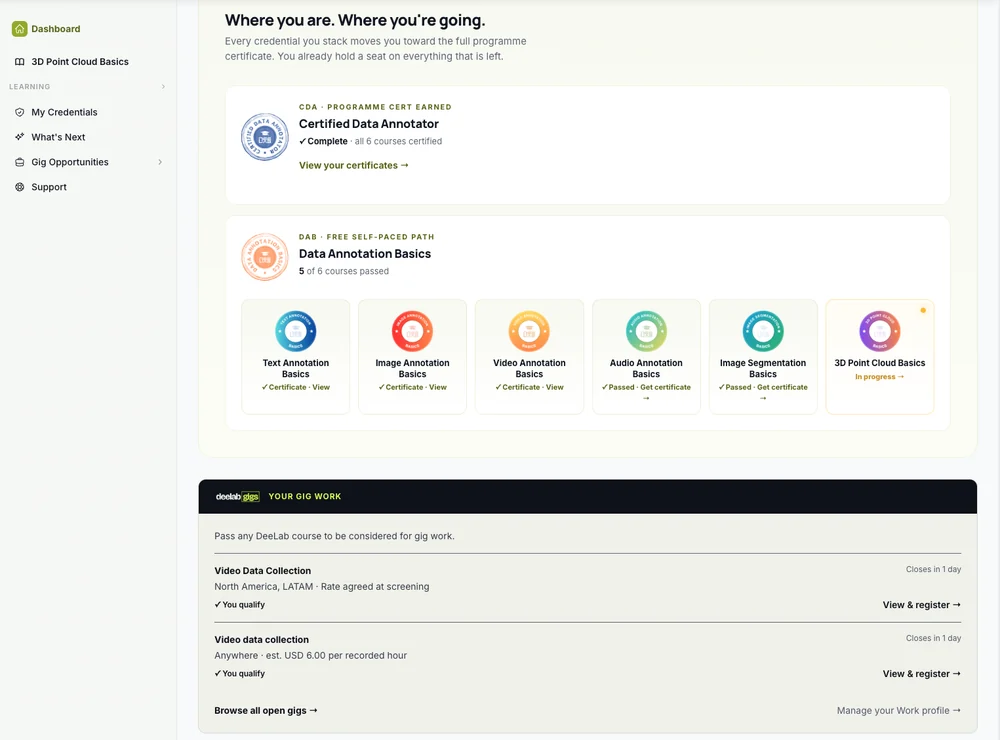
What we built
One system behind every part of the academy.
One login for learning and labelling
We run Label Studio and CVAT, the open-source annotation platforms, on servers we host for the academy, and connect them to the same Keycloak single sign-on as the academy and Moodle. Self-paced trainees go straight into their Moodle course. Live cohort trainees also land in Label Studio and CVAT to do real annotation work, without a second account or password.
A course only needs one of the two at a time, so a small control panel we built starts the one in use and stops the other. Both stay available; the server only carries the one that is working.
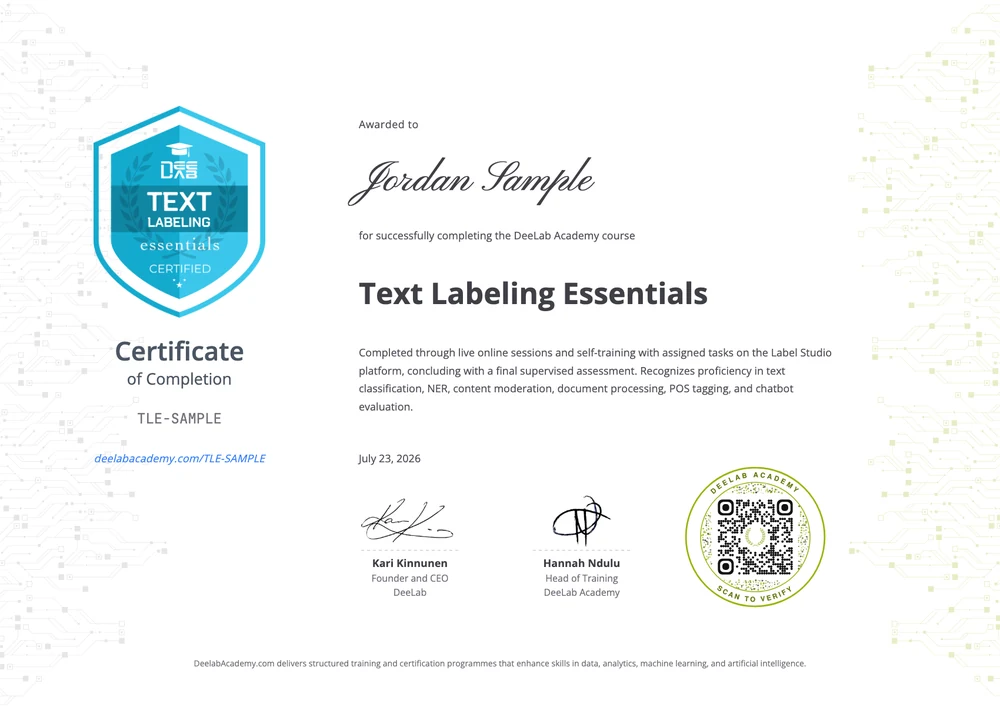
Certificates she controls
Every certificate carries a short verification address, a scannable seal and a certificate number. She decides whether to share it: by verification page and certificate number, or through the API into DeeLab Gigs. A private certificate stays inside DACCM. The certificate file carries its own proof in its metadata. A certificate issued in error can be withdrawn everywhere at once, while the audit trail stays intact.
AI helpers, with the guardrails built in
Each AI tool does one job: Daisy answers trainees, Staff Daisy supports trainers and course owners, Pulse reads growth, Fintan reads finance, another gathers product feedback, the AI Builder sets up programmes for organisations, and Annotation Studio puts AI inside the labelling tool. They draft and advise; the system enforces the limits. Staff Daisy only sees what each role may see, and the AI Builder changes nothing until a person clicks “Build it”. One daily AI budget and one master switch keep costs predictable.
The monthly Pulse check
On the 1st of each month, trainers and staff answer a short check-in on energy, direction and what went well or could be better. On the 3rd, Pulse sets their answers against revenue, bookings, pass rates, marketing and market research. A second AI challenges the analysis and asks the founder the questions only a person can answer. The founder’s answers shape the plan, the team can comment on it, and a month later every recommendation is graded on whether it worked.
Money in one place
Card and bank payments in several currencies confirm the same way. A finance dashboard shows revenue, margin and costs by course, cohort and country, and closed months stay locked. Partner invoices are drafted at month end.
Marketing tied to real bookings
The Demand Board lists cohorts with seats to fill, pages losing visits and past students ready for their next course, then suggests responses, cheapest first. Campaigns across on-site ads, email, LinkedIn, Google Ads and Microsoft Ads connect to real courses, and every click is traced to a confirmed payment. LinkedIn posts are written, scheduled, published and measured from DACCM. Prices are set for each country’s income level and currency.
Numbers that update themselves
A few examples of the metrics available in DACCM’s dashboards, which refresh on their own: growth against last month, new markets as they appear, where trainees arrive from and which channels bring visitors. What once took days to piece together is on screen whenever it’s needed.
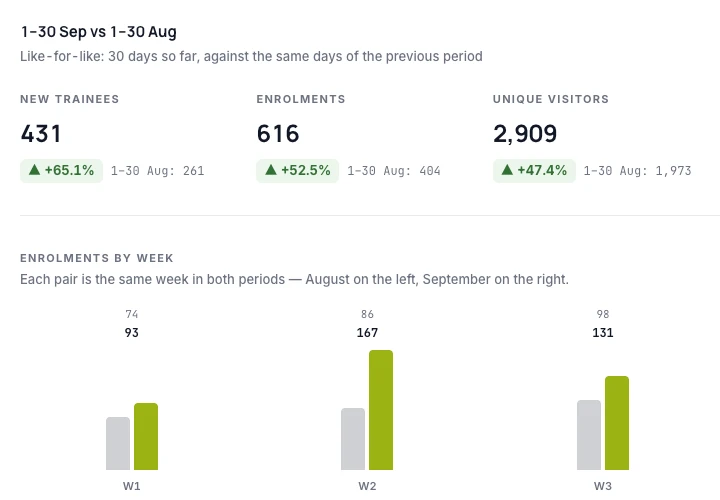
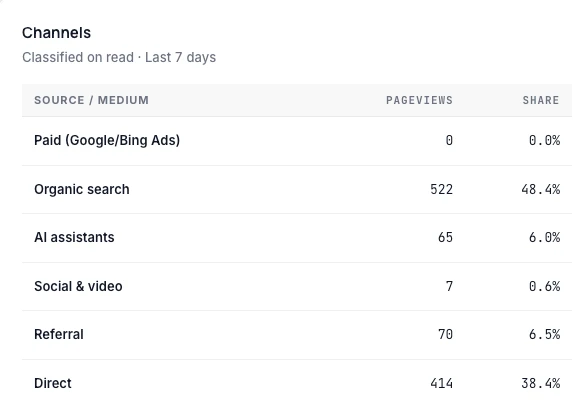
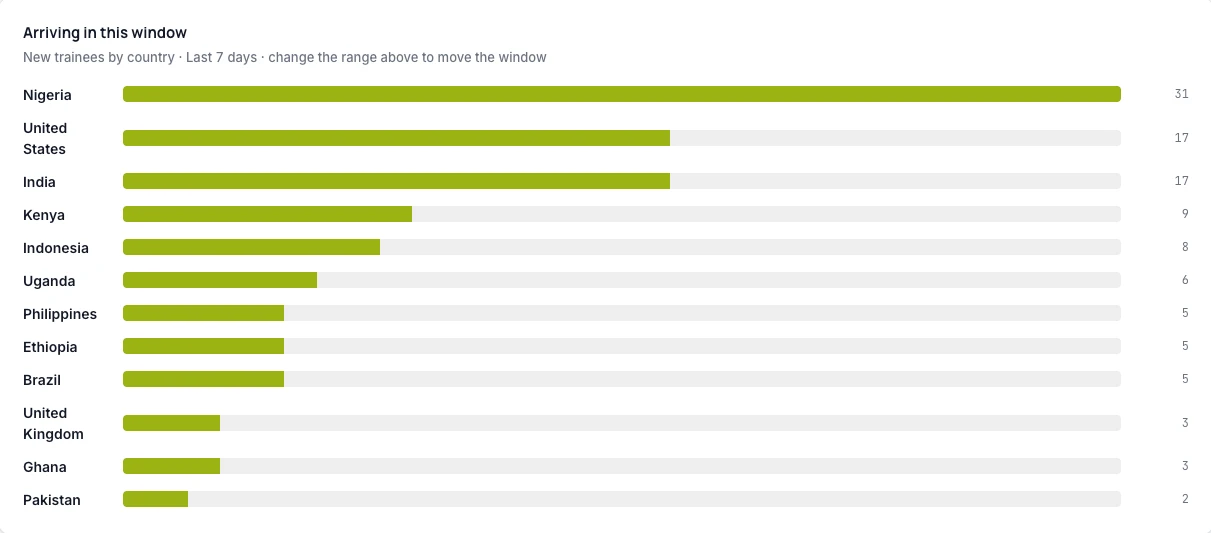

Screens from DeeLab Academy’s DACCM, September 2026.
Built to stay up
Every change passes more than 4,100 automated tests and a staging copy before it reaches production, and any release can be switched back in one step. Health checks on 29 integrations run every 30 minutes, with a real checkout test alongside. We build with AI coding agents under clear human authority: a person sets the goal, agents build and review, and nothing reaches production without sign-off.
Results
From manual steps to one record.
Jessica, now
Her payment is confirmed at once, and her confirmation email links straight to her account. Course details and tool access are waiting in her dashboard before the first live session. After she passes, her certificate issues automatically. She decides who can see it and her portfolio of all her certificates: by link, by certificate number, or also through search engines.
And after the course
Any course pass opens sign-in to DeeLab Gigs (opens in a new tab), where opportunities for data annotation and other data and AI work are growing. The two platforms share one login but keep separate data.
| Area | Run by hand | With DACCM |
|---|---|---|
| Course runs and sign-ups | Each course run opened and closed by hand; payments checked, trainees added to courses and emailed one by one | Course runs, sign-ups, payment checks, enrolment and emails run automatically |
| Trainee records | Web form submissions copied into Google Sheets | One record per trainee, from sign-up to every course passed |
| Tool access | Manual access management for Label Studio, CVAT and Moodle | Single sign-on to Moodle, Label Studio and CVAT, set up automatically |
| Self-paced courses | Not possible without adding manual work | Launched once DACCM automated the flow, sign-up to certificate |
| Certificates | Made one by one and added by hand to a verification page on deelab.ai | Created automatically; the trainee chooses to share by link, certificate number or API, or keep it private |
| Marketing | Planned by hand, one channel at a time | Campaigns built from course data via APIs; cost and results feed AI analysis for the next round |
| Reporting | Figures pieced together by hand | Finance, feedback, ratings, growth and web analytics, live in DACCM |
What’s next
Each next phase is shaped by trainee and staff feedback, business needs and data. Improvements to the interface and reporting ship regularly.
Questions
DACCM in brief.
- What is DACCM?
- DACCM (DeeLab Academy Course and Certification Management) is the platform that runs DeeLab Academy: the website, payments, cohorts, learning in Moodle, certificates, marketing and finance, in one application.
- Who built DACCM?
- Upsolut designed and built DACCM, and hosts and runs it. Upsolut and DeeLab Academy are both ventures of Tailjay Pte. Ltd., Singapore.
- What is DACCM built with?
- Laravel and PHP with MariaDB on Ubuntu Linux, Moodle for learning, Keycloak for single sign-on, Stripe and Wise for payments, and Anthropic Claude for its AI helpers.
- How can an employer check a DeeLab Academy certificate?
- Every certificate has a certificate number, a short verification address and a scannable seal. When the trainee chooses to share it, each of these leads to a public verification page, and the same record can be checked through a public API.
- Can Upsolut build a platform like this for us?
- Yes. We design and build platforms like DACCM for training, certification and service businesses, and stay on to run them. Start with a consultation.