


Case study · DeeLab Gigs
Trained people. Managed work.
How we built DeeLab Gigs, where companies hire managed data teams and people trained at DeeLab Academy find paid work. One login and a small API join it to the Academy; the data stays apart.
At a glance
- Project
- DeeLab Gigs, managed data teams and paid work for trained talent
- Client
- DeeLab Gigs, part of DeeLab.ai (Singapore)
- Industry
- Managed workforce for AI data collection and annotation
- Upsolut’s role
- Product design, engineering, hosting and support
- Live since
- August 2026
- Stack
- Laravel and PHP with MariaDB on Ubuntu Linux; Keycloak single sign-on; Google Drive and Docs APIs; Cloudflare; Anthropic Claude
- See it
- deelabgigs.com (opens in a new tab)
DeeLab Gigs is where companies come for data collection and annotation teams, and where people trained at DeeLab Academy find paid work. It is not a job board. Clients send a brief, DeeLab reviews it, prices it and fields a team, and the platform runs the work from first brief to the talent’s invoice.
The challenge
Trained people on one side, real work on the other.
DeeLab Academy was producing trained, assessed people. The work around them still ran on shared folders, group chats and email.
-
Talent in folders and chats
Who was available, what they had passed and what they would accept per hour lived in Google Drive, WhatsApp groups and email. Nobody could see the whole pool at once.
-
Credentials checked by hand
Every certificate and course pass had to be checked by hand, one person at a time, before anyone could be put forward for work.
-
Paperwork passed around
Client requests arrived as email threads. Prices were worked out case by case, and contracts and invoices were documents sent back and forth.
Jessica, before
Jessica, from the DeeLab Academy story, passed her course and had the certificate to prove it. Finding work was another matter. Her details sat in a folder, openings were shared in group chats, and each engagement meant a contract by email and an invoice she wrote herself.
What it needed
One place for every talent, fed by their real Academy record. A way for companies to ask for a team without creating an account. Pricing that holds up across countries. And every engagement run from contract to invoice without anyone chasing paperwork.
Our approach
Connected, never merged.
Gigs had to work as one family with the Academy without becoming part of it. Four rules shaped it.
One login, separate records.
One DeeLab account opens both the Academy and Gigs. Each keeps its own database, and they meet only through protected APIs and signed messages. Gigs reads the Academy record but never changes it.
Credentials from the source.
Certificates and passed courses come straight from the Academy, never retyped. The Academy decides what each viewer may see.
The work is vetted too.
A person reads every client brief before anything is staffed or published. If DeeLab cannot do the work well, it says so.
Money and mail wait for a person.
Anything that emails real people or moves money ships switched off and needs a named decision to turn on. The system drafts; people send, approve and pay.
The journeys
Two sides, one system. People decide where it matters.
Gigs handles the matching, the paperwork and the records. People make the calls that need judgement: which briefs DeeLab takes on, who works on them, and whether the client goes ahead.
- A person decides
- Where it leads
- The client or talent and the system
The client 7 steps · 3 decisions
Brief
- Sends a briefNo account needed. Work type, volume, timeline and budget in any of 153 currencies, with each group of people described on its own.
- A person reads itStaff qualify the brief and check it against the pool before promising anything.Staff decide
- Gets a priced quotePriced from a rate card staff sign off, adjusted by country, and sent as a private link that can be withdrawn.
- ConfirmsThe client accepts the quote and the work is set up.Client decides
Delivery
- A team is fieldedIndividuals, or a crew with a DeeLab team lead, drawn from the trained pool.Staff decide
- Work runsTimesheets, deliverables and ratings in one place. Quality checks and cover stay with DeeLab.
- Work deliveredDone to the brief by people trained for it, with DeeLab accountable for the result.
Jessica, the talent 8 steps · 1 decision
Join
- Passes an Academy courseAny passed DeeLab Academy course opens DeeLab Gigs.
- Signs in as she already doesThe same single sign-on as the Academy. No new account and no new password.
- Her profile is waitingHer certificates and passed courses come from the Academy. She adds her work types, languages, devices, availability and the lowest rate she will accept.
- Matched to suitable workMatching respects her own terms, including her minimum rate. Staff invite the best matches, and she sees the invitation in Gigs.
Work
- Registers her interestFrom the gig page, answering any screening questions the client has set.
- Chosen for the teamStaff pick the people for each engagement.Staff decide
- Accepts her agreementThe contractor agreement is accepted inside Gigs, and a signed copy is filed for both sides.
- Paid for her workGigs drafts her invoice from approved timesheets. She accepts it, and staff approve and record the payment.
What we built
One system behind every gig.
One login, two products, clean edges
Talent sign in with the same Keycloak single sign-on as the Academy. When a course is passed, a certificate is approved or withdrawn, or consent changes, the Academy sends Gigs a signed message. The message is only a signal: Gigs clears its copy and reads the record again from the Academy. In the other direction, the Academy shows Gigs’ open work through a feed from Gigs.
Gigs started as a module inside the Academy platform, built so it could be lifted out. Once gig work had its own clients, contracts and money, we gave it its own application, database and release cycle, and kept the join to the Academy as a small, versioned API.
AI with a narrow job
Staff paste a client’s brief and Claude drafts the request from it. It keeps the client’s money terms word for word and never produces a price. For talent, it offers to polish a profile bio and saves nothing unless they choose to.
The whole pool at a glance
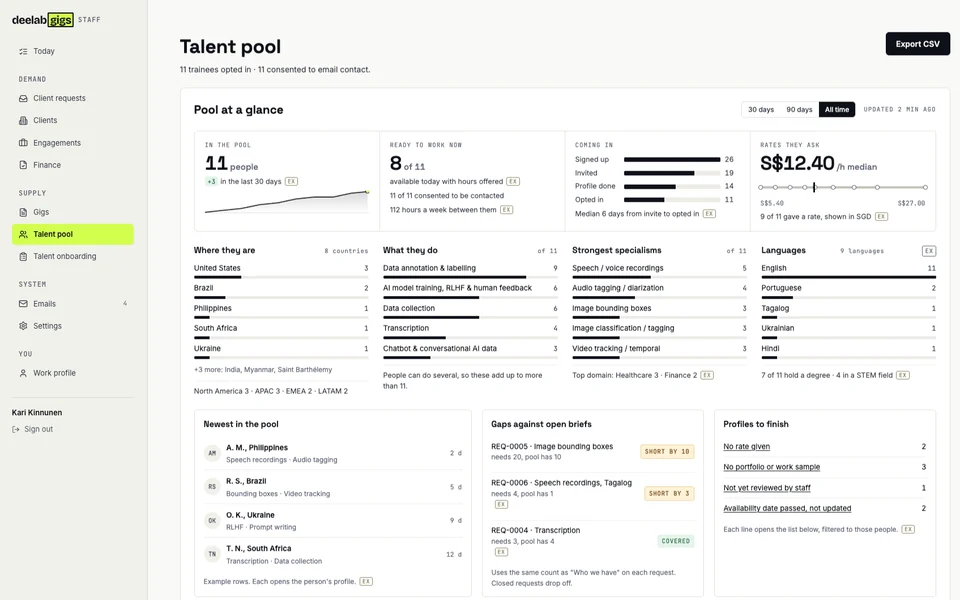
The staff console shows where people are, what they do, the languages they speak and the rates they ask, which profiles are still unfinished, and where the pool falls short of open briefs. Each breakdown opens the list of people behind it, so a gap becomes a to-do.
A brief form that asks the right questions
No account needed. Budget in any of 153 currencies, each group of people described on its own, since a team in Manila and a specialist in Berlin are different questions. Payment terms are asked up front, and every submission passes a spam check.
Prices built from evidence
A rate card whose values staff sign off one by one; changing a value clears its signature. Countries are banded by World Bank income class, with SGD as the base and live exchange rates. Gigs refuses to price a country it has not classified rather than guess. Quotes go out as private links that can be withdrawn.
Matching that respects people’s terms
Hard filters first: work types, languages at the level needed, regions, devices, working days and time zones, weekly hours, availability, and the person’s own minimum rate converted to SGD. Then ranking by evidence: language level, proven skills, experience, portfolio and spare hours.
Crews run in one place
Engagements move from proposed to complete, with a team lead, members, timesheets, deliverables and ratings. Nobody approves their own timesheet, team leads included. Staff plan the work by month and by person.
Contracts and invoices without paperwork
Talent accept the contractor agreement inside Gigs, and the signed PDF is filed to Google Drive with a fingerprint checked every night. Gigs drafts each talent’s invoice from approved timesheets. Payment details are encrypted, changing them needs a fresh sign-in, and every staff view is logged.
Open work, everywhere it should be
Open gigs are published on the site and in RSS, Atom and JSON feeds, with structured data so search engines can list real openings as jobs. Each gig gets its own share image. Client names never appear.
Messages with the consent attached
Staff message chosen groups of people, and each group carries the exact consent wording those people agreed to. Every email has a one-click unsubscribe, and every send is logged.
Built to stay up
Every change passes more than 2,700 automated tests and a staging copy before it reaches production. We build with AI coding agents under clear human authority: a person sets the goal, agents build and review, and nothing reaches production without sign-off.
Results
From group chats to one record.
Gigs completes the loop the Academy started. The Academy trains and certifies; Gigs puts that proof to work.
Jessica, now
Passing her course is no longer the end of the story. Her certificates are already on her Gigs profile when she first signs in, with the same login. When suitable work arrives, she is invited and sees it in Gigs. She registers her interest from the gig page, accepts her agreement on her phone and never has to type up an invoice.
For clients
A company sends one brief, without an account, and gets a priced quote at a private link. DeeLab fields the team from people it has trained, runs the work and keeps quality and cover in its own hands.
| Area | Run by hand | With DeeLab Gigs |
|---|---|---|
| Talent records | Folders in Google Drive, details scattered across chats | One profile per person, fed by their Academy record |
| Finding people | Asking around in WhatsApp groups | Filtered, ranked matching across the whole pool |
| Checking credentials | By hand, one person at a time | Read straight from the Academy |
| Client requests | Email threads | One brief form and a staff queue |
| Pricing | Worked out case by case | A signed rate card by country, with live exchange rates |
| Contracts | Documents sent back and forth | Accepted in Gigs and filed automatically |
| Talent invoices | Written by each person | Drafted from approved timesheets |
What’s next
Next come invoices to clients from the same records, automatic payouts through Wise, and opening the pool to invited specialists for work no Academy course covers yet.
Questions
DeeLab Gigs in brief.
- What is DeeLab Gigs?
- DeeLab Gigs is the platform where companies hire managed teams for AI data collection and annotation, and where people trained at DeeLab Academy find paid work. DeeLab reviews every brief, prices it and fields the team.
- Who built DeeLab Gigs?
- Upsolut designed and built DeeLab Gigs, and hosts and runs it. Upsolut and DeeLab are both ventures of Tailjay Pte. Ltd., Singapore.
- How does it connect to DeeLab Academy?
- Through one Keycloak login and a small, versioned API. Each product keeps its own database. Any passed Academy course opens Gigs, and certificates are read from the Academy rather than copied.
- What is DeeLab Gigs built with?
- Laravel and PHP with MariaDB on Ubuntu Linux, Keycloak for single sign-on, the Google Drive and Docs APIs, Cloudflare, and Anthropic Claude for its AI helpers.
- Do companies need an account to hire a team?
- No. A company sends a brief through the form, and its quote arrives at a private link that can be withdrawn.
- Can Upsolut build a platform like this for us?
- Yes. We design and build platforms like DeeLab Gigs for marketplaces, workforce and service businesses, and stay on to run them. Start with a consultation.